Is this the end of software programmers?
This week at work, my manager was complaining that developers are no longer looking at the code the AI is writing. He's afraid that the overall quality of our codebase is going to decrease. However, this trend will inevitably continue. Given the current situation, AI reliance is making us less inclined to push our cognitive boundaries, especially in fields like engineering and science. Many of my colleagues feel there is no longer a real challenge in their daily work, as AI now writes complex algorithms in seconds that used to take hours of deep technical problem solving. One of my colleagues was telling me the other day that he feels like he’s just grinding away, as everything is done by AI agents. It’s getting monotonous and boring for him.
It feels as though we've reached a point where we consult AI for the most trivial tasks. We simply aren't exerting the same intellectual effort we used to. The proliferation of "AI slop" is a sign of this decadence.
The Signs of Intellectual Atrophy
This shift isn't just a feeling inside tech companies, it's manifesting across multiple areas of society:
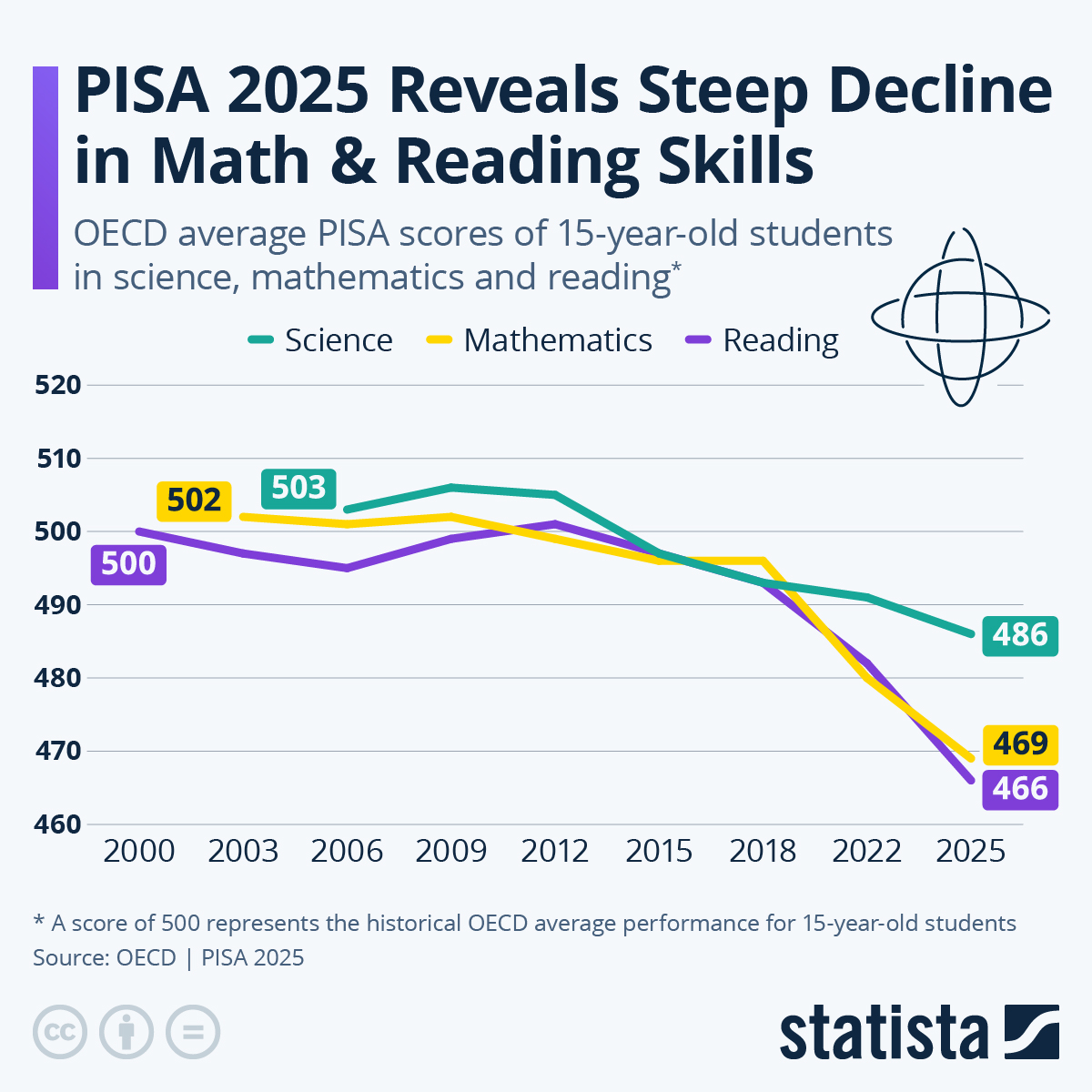
- Declining Educational Benchmarks: The PISA 2026 results show a sharp global decline in educational performance, highlighting how offloading core critical thinking and problem solving to automated tools is impacting learning at scale. Students now use AI to do their homework, and as a result, they are losing critical thinking, long-term memory, investigative and problem solving skills.
- Unchecked Pull Requests at Work: In my day-to-day work as a software developer, almost no one is doing rigorous code reviews on AI-generated snippets anymore. Pull Requests are increasingly being approved as-is, trusting the model's output without verification.
- The Rise of Blind "Vibe Coding": Content creators are actively teaching people how to "vibe code", building full applications without understanding a single line of the underlying logic, and often without even taking the time to read the AI's explanation. People don't like reading, why should they read what the AI is telling them?
- Job Postings Are Shifting: Companies are rapidly updating their hiring criteria, explicitly advertising roles for "AI Experts" or "Prompt Engineers" rather than traditional "Software Programmers". People won't, in consequence, acquire the traditional skills required to become a traditional software programmer.
Accepting the New Reality
As concerning as this might sound to veteran engineers (resistance to change is really a strong thing!), let's accept it: this is the undeniable future of software development. Eventually, AI models will become so hyper efficient at code generation and formal verification that manually auditing generated code will be unnecessary. Writing code by hand will soon be viewed not as a craft, but as an inefficient bottleneck.
I view this paradigm shift as remarkably similar to the transition from Assembly language to high-level compiled languages like C or Python. Decades ago, programmers worried that moving away from direct register manipulation and memory management would make coders lazy and produce sub-optimal software. Instead, abstraction allowed us to build systems of unprecedented complexity using human readable syntax. One of the selling points back then was that high-level languages allowed you to use natural language to code, using English words like "while", "if", "for", etc., instead of the complex mnemonics used by assembly language like JMP, NOP and MOV. With AI, coding in literal English (and other languages of course, which I personally do to practice my language skills) is more of a reality than ever before.
"Vibe coding" and natural language prompt development are simply the next layer of abstraction. We are no longer programming the hardware, we are instructing the intelligence layer that manages the hardware.
Final Thoughts
Is this the end of software programmers? In the traditional sense of sitting down to type syntax and debug pointers: I'd say a resounding YES!. But it also marks the beginning of a new era where architectural vision and system orchestration matter far more than knowing every language keyword by heart. That's why I started studying for my Claude Certified Architect exams, because let's be honest, software development as we know it is going away.
How do you feel about the transition toward complete AI code generation? Do you still review the code your AI writes, or have you embraced vibe coding? Let me know in the comments below!