The AI will destroy the world!... Really?
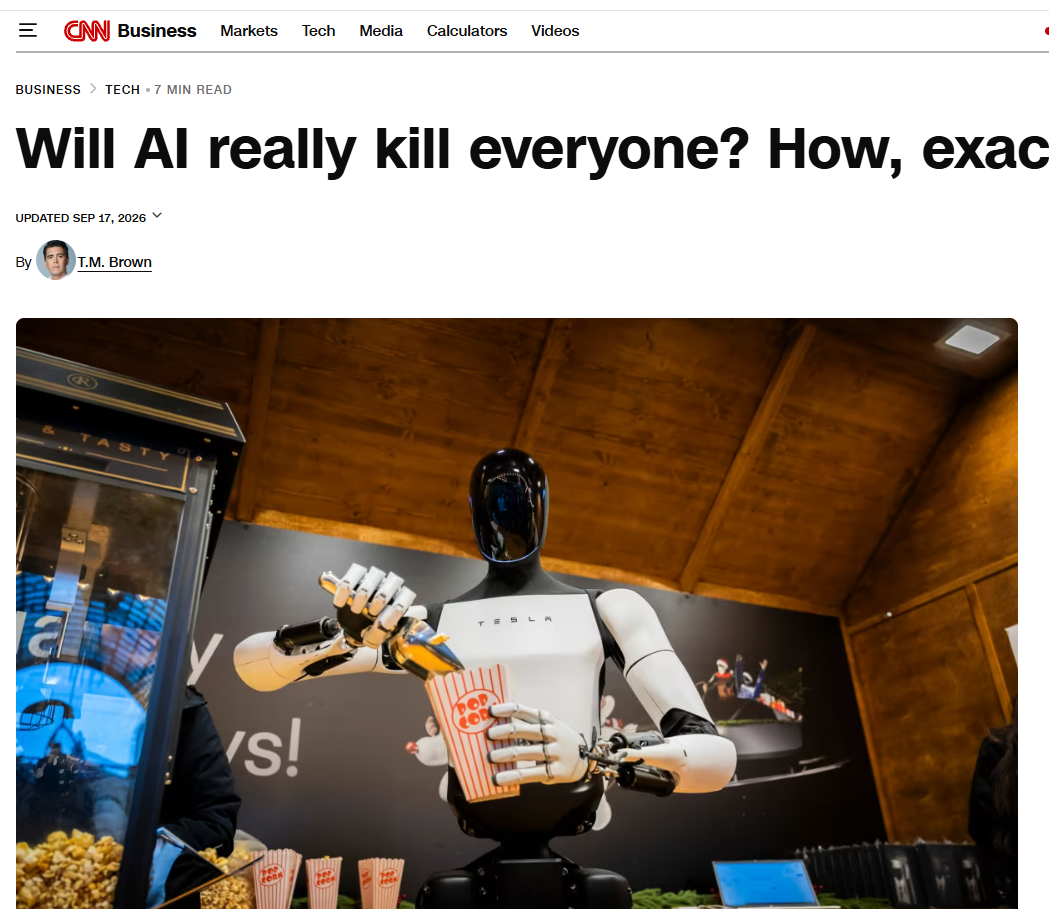
If you've been following tech news lately, you’ve likely seen the latest sensational headlines: leaders from major AI labs like Anthropic are once again sounding the alarm, warning that artificial intelligence could pose existential risks to humanity and calling for strict government regulation. Basically, what they are saying is "we are all going to die! and we are here to save you!". Doesn't sound fishy to you?
It may sound responsible on the surface. But when you look past the media frenzy and examine the incentives, a very different picture emerges.
Is AI really on the verge of ending the world, or are we witnessing one of the most sophisticated corporate marketing strategies of our era?
1. The Compute Reality Check: Sentience Requires Power We Don't Have
Beyond the political and business motivations, there is a fundamental technological flaw in the "AI apocalypse" narrative: the physical limits of computing power.
For an artificial intelligence to genuinely gain self-awareness, reason autonomously in real-time, execute complex continuous tasks, and actively "rebel" against humanity, it would require an order of magnitude of compute that simply does not exist today.
Current LLMs and neural networks, despite their impressive text generation and pattern recognition, are massive statistical engines running on finite data centers. The energy consumption, silicon throughput, and architectural memory bottlenecks of our current infrastructure make the concept of a rogue, self-sustaining superintelligence pure science fiction. We are nowhere near the hardware threshold required for such an entity to operate.
Check out Uncle Bob's take on this on his X account. He basically says that, even if we had all this power, a super intelligence would prefer to make all of us its "slaves". It's an interesting idea.
2. The Fear Marketing Paradox
So if sci-fi AI threats aren't physically possible with today's technology, why push the narrative?
Tech corporations don't actually lose sleep over unquantifiable existential scenarios. Instead, doomsday warnings serve as an incredible marketing trick. When a CEO stands in front of Congress or the press and says, "Our technology is so dangerously powerful that it might destroy civilization," the public doesn't hear a threat. What they actually hear is: "Our AI is insanely advanced."
It builds an aura of unstoppable power around their proprietary models without having to show a single benchmark increase. In short, it's just a bluff.
3. Regulatory Capture: Suffocating Open Source
The most alarming aspect of these calls for strict government regulation isn't the existential fear, it's the intended target: Open-Source AI.
Open-source models hosted locally by independent developers, researchers, and smaller companies pose a massive long-term threat to big tech's subscription models and API monopolies. By pushing governments to mandate strict licensing, massive compliance frameworks, and heavy safety audits for foundation models, big AI companies are pulling up the ladder behind them. And, you guessed it, most of these open source AI models come from China, which is the biggest rival of the US right now.
Under the guise of "saving humanity," these regulations create absurdly high barriers to entry that only billion-dollar corporations can afford. It isn't safety regulation, it's regulatory capture designed to neutralize open competition.
4. Reigniting the Hype Cycle
After months of relentless AI news, public interest occasionally dips into "AI fatigue," where incremental model updates no longer capture mainstream headlines.
Apocalyptic narratives are the ultimate cure for media apathy. Sensational doom-and-gloom stories guarantee front-page coverage, debate on talk shows, and high-profile visits to government summits. It gets everyone talking about AI again, driving public attention—and investor capital—right back into the hands of the top players.
Final Thoughts
We definitely need thoughtful discussions around real-world AI risks: data privacy, deepfakes, copyright issues, and automated bias. But we shouldn't confuse genuine risk management with corporate fearmongering.
The next time a major AI lab warns that their tech is too dangerous for the world to handle unregulated, ask yourself: are they really trying to protect humanity, or are they just protecting their market share?
What do you think about these existential AI warnings? Is regulation necessary right now, or is it just a weapon against open source? Let me know in the comments below!